 ultimate-guide
Choosing the Right Preschool for Your Child: 2026 Guide
Table of Contents
- Start With Your Child and Your Family Priorities
- Montessori vs Traditional Preschool: Which Fits Your Child
- How to Find and Shortlist Local Preschools
- Your Preschool Tour Checklist: What to Look For
- Questions to Ask When Choosing a Preschool
- Check Costs, Licensing, and Contract Terms Before You Commit
- Preschool Readiness Signs and the Transition to School
- Conclusion
- Frequently Asked Questions
Last Updated: October 20, 2026
Start With Your Child and Your Family Priorities
Choosing the right preschool for your child starts with a clear-eyed look at who your child is, not at which program has the nicest brochure, and choosing the right preschool is a decision you make in stages.
A common mistake is touring schools before you've defined what you actually need. Parents fall for a beautiful classroom and then realize the schedule doesn't fit their workday or the philosophy clashes with how they parent. Start here instead:
- Map your child's temperament. Does your child dive into new rooms or cling to your leg for ten minutes? A shy child may need a smaller class size and a slower settling-in process; a bold one may thrive on more freedom to roam.
- Name your non-negotiables. Location, hours, potty-training policy, allergy handling, holiday schedule. Write them down before you tour anything.
- Agree on your educational philosophy. Do you want play-based learning, structured learning, or a specific method like Montessori? This single decision eliminates half your list.
- Set your budget ceiling. Know your monthly number before you fall in love with a program.
The real difference between a good fit and a great fit comes down to how well the classroom environment matches your child's personality and your family's daily reality. Get that match right and everything else gets easier.
Montessori vs Traditional Preschool: Which Fits Your Child
Montessori and traditional preschools differ in who directs the learning. In a Montessori classroom, children choose activities from prepared shelves and work independently; in a traditional preschool, the teacher leads the group through a set curriculum.
Neither approach is universally better.
Here's what most guides miss: authentic Montessori requires trained teachers and a full set of specific materials, and not every school using the name delivers that.
How to Find and Shortlist Local Preschools
Shortlisting works best as a funnel: gather broadly, then cut ruthlessly. Many families find that starting with eight to ten local preschools and narrowing to three for visits keeps the process manageable.
- Ask other parents, pediatricians, and librarians for names, then check state licensing records for each one.
- Filter by your non-negotiables first: hours, location, and budget remove most options quickly.
- Verify licensing and inspection history through your state's child care licensing agency, which typically publishes inspection reports.
- Read parent reviews for patterns rather than single complaints.
A program confident in its work will welcome the scrutiny.
Your Preschool Tour Checklist: What to Look For
A preschool tour is your best chance to see the classroom as it actually runs. Watch the children, not the director.
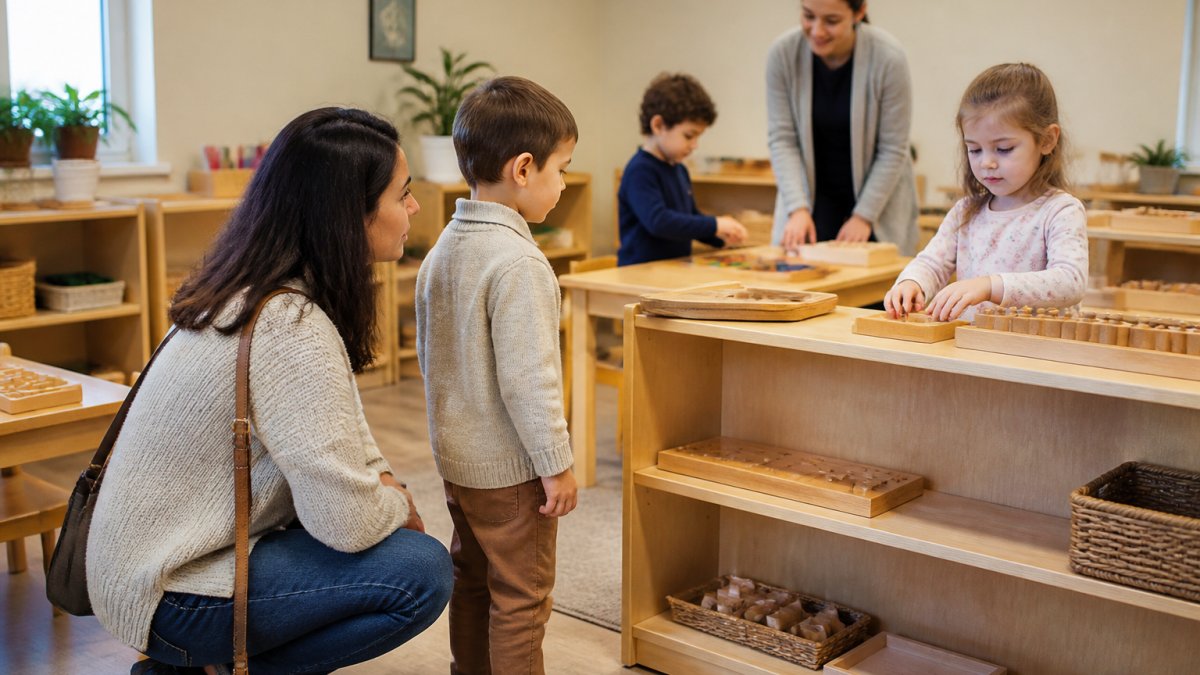
Score what you see, not what you're told. Rate each item from 1 (weak) to 5 (strong) on every tour, and keep the scores in one place so you can compare schools side by side afterward.
- Engagement: Children look absorbed in what they're doing, not bored, wandering, or herded from activity to activity.
- Teacher-child interaction: Teachers get down to eye level, speak calmly, and respond to children by name.
- Supervision and ratios: You can see every child at all times, and the adult-to-child ratio in the room matches what the director quoted.
- Environment: Shelves and materials are organized, accessible to children, and in good repair; the room feels calm rather than chaotic.
Watch for these red flags. A positive checklist is only half the picture. Note anything that gives you pause, and follow up with the director in writing afterward:
- Poor supervision, teachers on phones, clustered together talking, or children out of sight in another room or on the playground.
- Dismissive communication, questions deflected, vague answers about ratios or licensing, or a director who talks over you.
- Chaos without repair, a loud, disorganized room where no adult is helping children re-engage.
- Harsh or sarcastic tone from staff toward children, or children who flinch or go quiet when an adult approaches.
Turn your notes into a decision. After your visits, build a simple weighted scorecard.
Questions to Ask When Choosing a Preschool
The right questions reveal how a program actually operates day to day. Bring this list to every visit.
Ask directors:
- What are your teachers' qualifications and how long have they worked here?
- What is your adult-to-child ratio in each classroom?
- How do you handle separation anxiety and settling in?
- What does your daily routine look like, and how much outdoor time do children get?
- How do you communicate with families about my child's development?
Ask teachers:
- How do you support a child who is struggling socially or emotionally?
- How do you individualize for a child who learns differently?
- What does a typical morning look like for the children?
A common mistake is asking only about curriculum. Teacher experience and teacher-child interactions shape your child's day far more than the lesson plan on paper.
Check Costs, Licensing, and Contract Terms Before You Commit
Cost and contract details deserve the same scrutiny as the classroom, and this is where most preschool guides go quiet.
Build a cost comparison sheet. For each school, record:
- Base tuition by schedule (part-day vs. full-day, 2/3/5 days per week) and by age group, rates often step up in the older classrooms.
- Registration or enrollment fee, usually charged once, sometimes annually, and typically non-refundable.
- Deposit and whether it is applied to tuition or held as a separate security deposit.
- Supply, material, and technology fees, ask whether these are billed once a year or per term.
- Meals and snack charges, included, billed monthly, or packed by families.
A useful sanity check: add up the base tuition plus every mandatory fee for a full year, then divide by twelve.
Read the contract like a lease. Request the full enrollment agreement in writing before you sign, and read these clauses closely:
- Withdrawal and cancellation terms, how much notice is required, what happens to the deposit, and whether you owe tuition through the end of the month, term, or year.
- Rate-increase clause, how much notice the school must give before raising tuition, and whether increases can happen mid-year.
- Schedule-change and drop-in policies, the process and any fees for adding days or switching from part- to full-time.
- Illness, absence, and closure policies, whether tuition is credited for sick days, holidays, weather closures, or staff in-service days.
- Disenrollment by the school, the conditions under which a program can ask a family to leave, and the notice it must give.
- Dispute and refund language, how refunds are calculated and how disagreements are handled.
Never enroll without a written withdrawal policy. Families who leave mid-year without understanding the notice period can lose a deposit or owe additional tuition. Ask specifically: "If we withdraw on the first of next month, what exactly do we owe?" Get the answer in writing.
Verify licensing and inspection history, don't take it on faith. Preschools and child care programs are regulated at the state level, and most states publish licensing records, inspection reports, and complaint or enforcement history through a child care licensing agency or a searchable online portal. Before you commit:
- Confirm the program's current license type and status, and that the license covers the ages and hours your child will attend.
- Pull the most recent inspection reports and read any deficiencies or corrective-action notes, a single citation is common and not automatically disqualifying, but a pattern of repeat findings in supervision, ratios, or health and safety is a serious signal.
- Ask whether the program is accredited by a national accrediting body, and confirm the accreditation is current rather than expired.
- Ask the director directly how the program responded to its last inspection findings, and whether you can see the corrective-action plan.
- Check whether the program participates in any state quality-rating system, and what rating it holds.
If a program is evasive about licensing records or won't share its fee schedule and contract before you sign, treat that as information in itself.
Preschool Readiness Signs and the Transition to School
Preschool readiness signs are practical, not academic.
For children with sensory sensitivities or anxiety in unstructured settings, ask how teachers support individualized needs and whether the environment can be adapted. A good program will describe specific strategies, not just reassurance.
Plan the transition deliberately: visit together, keep goodbyes short and confident, and expect a few bumpy weeks. Separation anxiety is normal and usually fades with consistency.
Conclusion
The search for the right preschool asks a lot of you: honest self-assessment, careful visits, and hard questions about cost and licensing. It's worth the effort, because the fit you choose shapes your child's first experience of school. Maria's Meadow Montessori School offers a nurturing, Montessori-rooted environment with a child-led curriculum, and a community that welcomes parent questions. We're currently enrolling and happy to arrange a visit.
Frequently Asked Questions
How do I choose the right preschool for my child?
Start with your child's temperament and your family's priorities, then compare programs on the things that matter most: class size, adult-to-child ratio, teacher qualifications, daily routine, and how the school handles separation and settling in. Visit at least three preschools, use a written tour checklist so your notes are comparable, and ask directors the same set of questions at each stop. Choosing the right preschool comes down to fit, not reputation. A program that suits a highly independent child may overwhelm a shy one, so observe how teachers respond to the children already enrolled.
What should I look for when touring a preschool?
Bring a preschool tour checklist and watch the classroom in action rather than the lobby. Look for children who are engaged and comfortable, teachers who crouch to child level and speak calmly, shelves organized so children can reach materials themselves, and clear supervision with sightlines across the room. Check safety measures such as secured entry, outlet covers, and a posted emergency plan. Ask how the daily routine flows and how conflicts between children are handled. Take notes immediately after each visit, because impressions blur once you have seen three or four schools in a week.
What questions should I ask a preschool director?
Ask about teacher qualifications and turnover, the adult-to-child ratio in each classroom, how the curriculum is planned, and how progress is communicated to families. Request the school's licensing status and inspection history, and ask how complaints are handled. Ask what happens when a child struggles with separation, sensory sensitivities, or aggression. Finally, ask about tuition, payment schedules, notice periods, and refund policies in writing. Questions to ask when choosing a preschool should cover teaching, safety, communication, and money, because a program can look warm on a tour and still be a poor fit on paper.
How is Montessori different from traditional preschool?
Montessori classrooms group children in mixed ages, use hands-on materials arranged on open shelves, and let children choose work within limits set by the teacher. Traditional preschools more often run teacher-led circle time and whole-group activities on a fixed schedule. Montessori vs traditional preschool is less about one being better and more about which suits your child. A child who focuses deeply on one task may thrive in Montessori. A child who needs frequent adult direction may settle faster in a more structured setting. Visit both types and watch how the children behave, not just how the room looks.
What are the signs my child is ready for preschool?
Preschool readiness signs include separating from you for a few hours without prolonged distress, following simple two-step directions, communicating basic needs, and showing interest in other children. Most children start between ages two and a half and three, but readiness varies. Your child does not need to be toilet trained or know letters to start. Visit the school together, ask about phase-in schedules, and expect a settling period of a few weeks. If your child has sensory sensitivities, tell the director before enrolling so teachers can prepare the environment.
What should I check about licensing and safety before enrolling?
Ask for the school's license and confirm it is current, then request the most recent inspection report and any complaint history. In most states, child care licensing records are public and can be requested from the state licensing agency. On site, check secured entry, sign-in and sign-out procedures, supervision during outdoor play, food handling, and medication policies. Ask how staff are trained in first aid and emergency procedures. A school that answers these questions openly and promptly is usually one that runs a tight operation.