 how-to
How to Teach Reading and Math the Montessori Way
Last Updated: October 28, 2026
Quick Summary
Montessori reading teaches sounds before letter names using sound games, sandpaper letters, the movable alphabet, and three-part cards, while math moves from golden beads and number rods to written symbols. Children follow a concrete-to-abstract progression at their own pace, with short individual lessons guided by a teacher.
- The three-period lesson moves from naming to recognition to recall, and rushing the recall step is the most common home-teaching mistake.
- Each lesson takes 5 to 10 minutes, and you present one at a time.
- Introduce the movable alphabet once the child knows 8 to 10 letter sounds.
- Move to the next lesson when the child works unprompted, self-corrects, and chooses the material independently.
- A 2024 review in the Journal of Montessori Research found Montessori reading methods line up with the science of reading.
Table of Contents
- How Montessori Reading and Math Instruction Works
- Montessori Phonics Activities: The Path to Reading
- Montessori Math Materials and the Decimal System
- Step-by-Step Lesson Sequence for Reading and Math
- Montessori Math Activities at Home
- Matching Lessons to Age and Readiness
- Tracking Progress Without Tests
- Enrolling Your Child in a Montessori Reading and Math Program
- Frequently Asked Questions
How Montessori Reading and Math Instruction Works
Montessori reading and math instruction methods teach reading and math through hands-on materials, not worksheets. Children move from touching real objects to writing symbols, at their own pace, with a teacher guiding short individual lessons. That is the whole idea in one sentence.
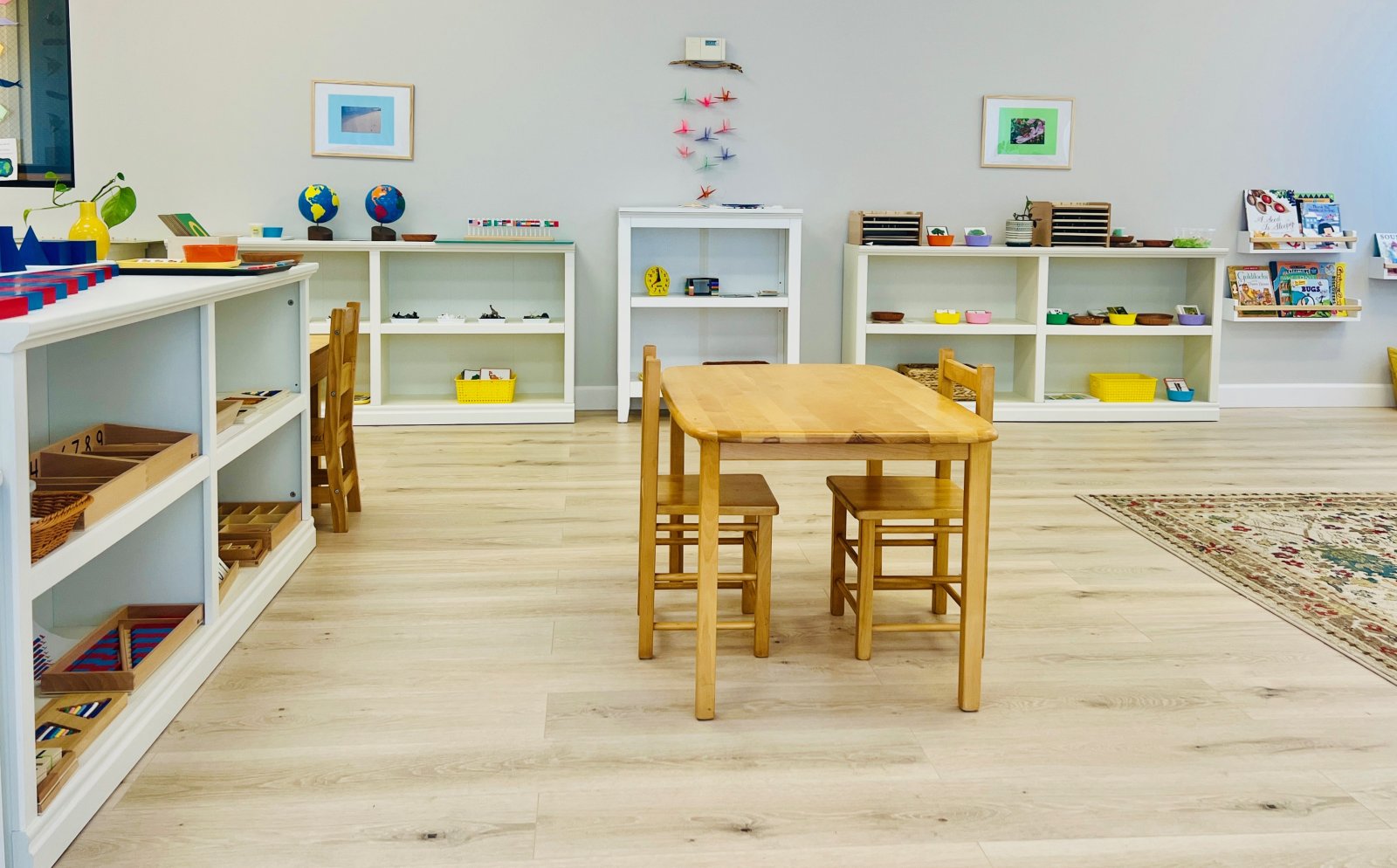
At Maria's Meadow Montessori School, we build every lesson around that sequence. And the research backs it: a review of studies reported by K-12 Dive's coverage of Montessori research found "strong and clear effects" of Montessori education on math, literacy, general academic ability, and executive function.
Below is a step-by-step lesson sequence you can follow at home.
The Concrete-to-Abstract Progression
A child who counts ten golden beads, then writes "10," has done something a flashcard can't replicate. She has felt the quantity.
This is the concrete-to-abstract progression: real objects first, then pictures, then symbols.
Why does it matter? Because the hand teaches the brain. A four-year-old tracing a sandpaper numeral learns the shape through touch. Later, writing it feels familiar.
What the Research Says About Outcomes
The evidence is promising but not simple. The American Montessori Society's research summary reports that Montessori students scored significantly higher in reading, with no significant difference in math scores, based on Brown & Lewis (2017).
A 2025 study in Scientific Reports found larger reading gains in kindergarten for Montessori children. But those reading advantages no longer showed up later on.
So what should parents take from this? The child-led philosophy behind these methods is worth understanding too: benefits of child-led learning in early childhood.
Montessori Phonics Activities: The Path to Reading
Montessori reading starts with sounds, not letter names. A child learns "mmm" for the letter m before anyone says "em." That order matters more than most parents realize.
The sequence looks like this:
- Sound games: "I spy something that starts with /b/."
- Sandpaper letters: the child traces the letter while saying its sound.
- Movable alphabet: the child builds words from loose letters before writing them.
A 2024 review in the Journal of Montessori Research found that Montessori reading methods and practices line up with the science of reading.
Montessori phonics activities stay playful. No timed drills. No pressure. Just repetition, which Montessori pedagogy treats as essential.
Montessori Math Materials and the Decimal System
Montessori math materials make the decimal system physical. The golden beads are the star: a single unit bead, a ten-bar, a hundred-square, and a thousand-cube. A child holds place value in her hands.
Other core materials include:
- Number rods for quantity and counting
- Spindle boxes for zero and number recognition
- Cards and counters for odd and even numbers
The materials are self-correcting. If the beads don't fit the card, the child sees the mistake without a teacher saying a word. That builds independent learning and problem-solving fast.
Step-by-Step Lesson Sequence for Reading and Math
This is the part most Montessori overviews skip: the actual mechanics of a lesson. A Montessori lesson has a predictable shape, invite, model, guide, step back, and that shape is what makes the method work at home as well as in a classroom. Each lesson below takes 5 to 10 minutes, and you present one at a time.
The Three-Period Lesson (the engine behind every material)
Before the sequence, learn the three-period lesson. It is the backbone of Montessori instruction and the reason materials are introduced in a specific order.
- Naming (This is...): You point to the object and say its name or sound. "This is /m/." "This is a ten-bar."
- Recognition (Show me...): You ask the child to identify it. "Show me /m/." "Show me the ten-bar." The child points or picks it up.
- Recall (What is this?): The child names it independently. "What is this?" Only move to period three when periods one and two are solid.
Most practitioners find that rushing period three is the single most common home-teaching mistake. If the child hesitates, drop back to period two without correcting sharply.
Reading Sequence
Lesson 1, Sound games (ages 2.5-3.5). Gather three objects with distinct initial sounds (e.g., a ball, a cup, a sock). Say: "I spy something that starts with /b/." The child picks it up. Progress to beginning, then ending, then middle sounds. No letters are shown yet.
Lesson 2, Sandpaper letters (ages 3-4). Introduce one letter at a time, using the three-period lesson.
Lesson 3, Movable alphabet (ages 4-5). Once the child knows 8-10 letter sounds, lay out the movable alphabet. Say a short vowel-consonant word aloud ("cat"). The child finds the letters and builds the word. Do not require handwriting yet, the movable alphabet lets the child encode words before the hand can form letters. Move from CVC words to blends ("flag") and then to short phrases.
Lesson 4, Picture and word matching (ages 4.5-5.5). Use three-part cards: a picture, a label, and a combined picture-with-label card.
Lesson 5, Phrase and sentence reading (ages 5-6). Introduce command cards ("Put the red cube on the mat") that the child reads and performs.
Math Sequence
Lesson 1, Counting with quantity (ages 2.5-3.5). Count real objects one to ten, touching each as you say the number.
Lesson 2, Number rods (ages 3-4). Line up the rods from shortest to longest.
Lesson 3, Sandpaper numerals and spindle boxes (ages 3.5-4.5). Trace sandpaper numerals while saying the number name.
Lesson 4, Golden beads and place value (ages 4-5). Lay out one unit bead, one ten-bar, one hundred-square, and one thousand-cube.
Lesson 5, Regrouping (ages 5-6). Trade ten units for one ten-bar. Say: "Ten units make one ten." Repeat with ten tens for one hundred. This is the concrete root of carrying and borrowing, and it is why Montessori children often meet regrouping before they meet a written algorithm.
How to Know a Lesson Is Ready to Move On
You do not need a test. Watch for three signals: the child completes the work without prompting, self-corrects when something is wrong, and chooses the material independently. When all three appear, introduce the next lesson in the sequence. If only one appears, keep practicing.
Montessori Math Activities at Home
You don't need a full classroom shelf. You need a tray, a mat, and everyday objects. Try these Montessori math activities at home:
- Bean counting: ten dried beans into a small bowl, one at a time.
- Coin sorting: pennies, nickels, dimes, quarters by size and value.
- Kitchen measuring: fill cups with rice to feel half and whole.
For more ideas, see our guide to Montessori activities for toddlers.
A common mistake is buying materials before the child shows readiness. Start with what you have. Add one material at a time.
Matching Lessons to Age and Readiness
Age is a rough guide, not a gate. Montessori classrooms are multi-age by design precisely because readiness varies widely within a single birthday year. Use the table below as a map, then use the readiness indicators underneath it to decide what to present next.
| Age | Reading Focus | Math Focus |
|---|---|---|
| 2.5-3 | Sound games, spoken vocabulary, rhyming | Counting objects to 5, matching and sorting |
| 3-4 | Sandpaper letters (8-10 sounds), beginning sound isolation | Number rods, sandpaper numerals, spindle boxes 1-10 |
| 4-5 | Movable alphabet, CVC word building, picture-word matching | Golden beads, place value to 1,000, regrouping ten units |
| 5-6 | Phrase and sentence reading, command cards, simple stories | Addition and subtraction with beads, fraction insets, skip counting |
| 6-7 | Fluent decoding, spelling patterns, reading comprehension | Multiplication as repeated addition, fraction equivalence, decimal system operations |
Readiness Indicators (what to watch for)
A child is ready for the next lesson when you see the current one used independently. Concrete signals:
- For sandpaper letters: the child can identify at least 8 letter sounds by ear in a sound game, and traces a letter while saying its sound without prompting.
- For the movable alphabet: the child knows 8-10 sounds and can segment a three-sound word aloud ("c-a-t").
- For golden beads: the child counts to ten reliably with one-to-one correspondence and can build a two-digit number with ten-bars and units.
If a child is not showing these signals, the answer is more practice with the previous material, not a new one. Most practitioners find that repeating a lesson for several weeks is normal and productive.
Adapting for Different Learners
Children who need more challenge. Offer the next material in the sequence early, but keep the presentation short.
Children who need more support. Slow the sequence and reduce the set. Introduce two sandpaper letters instead of four.
Multilingual learners. Teach the sound in the language of instruction first, then bridge.
Children with learning differences. The concrete-to-abstract sequence and self-correcting materials are often a good fit for children who struggle with worksheets.
Tracking Progress Without Tests
Montessori classrooms don't give tests to young children. Teachers observe instead. They record what a child chooses, how long she stays with it, and where she gets stuck.
At home, keep it simple:
- Note which letters she knows by sound
- Note which numbers she can build with beads
- Note whether she self-corrects or asks for help
Review your notes monthly. You'll see the sequence moving forward, which is the only progress report that matters at this age.
Enrolling Your Child in a Montessori Reading and Math Program
A good program shows you the materials and lets you watch a lesson. Ask how the teacher presents new work, how progress is tracked, and how reading and math connect across the day.
At Maria's Meadow Montessori School, we're open and accepting new enrollments. Schedule a tour at Maria's Meadow Montessori School in Martinsville, NJ. Our classrooms follow the Montessori approach.
Frequently Asked Questions
How does Montessori teach children to read?
Montessori reading starts with spoken language and sound awareness, then moves to sandpaper letters the child traces while saying the sound. Children build words with a moveable alphabet before writing them by hand. A 2024 review in the Journal of Montessori Research found these methods align with the science of reading. The sequence is sound, then word building, then reading connected text, so children decode before they are asked to memorize sight words.
What Montessori math materials help children learn math?
Number rods introduce quantity from one to ten. Spindle boxes and sandpaper numerals build number recognition and the concept of zero. The golden beads teach place value and the decimal system, then support addition, subtraction, multiplication, and division. Fraction insets come later. Each material isolates one idea, so a child sees the concept in their hands before meeting it as an abstract symbol. A 2025 Scientific Reports study found larger kindergarten reading gains but no lasting reading advantage later, so results vary by skill and age.
At what age do children typically begin reading and math activities in Montessori?
Most children start practical life and sensorial work around age 2.5 to 3. Number rods and sandpaper letters often appear between ages 3 and 4, and moveable alphabet word building around age 4. Reading simple phonetic words and golden bead place value work usually arrive between ages 4.5 and 6. Readiness matters more than the calendar: a child who can sort, sequence, and follow a two-step instruction is ready for the next material, whether or not they have hit a specific birthday.
How can parents support Montessori reading and math learning at home?
Keep it concrete and short. Trace sandpaper letters, play sound games like I Spy for initial sounds, and count real objects such as spoons or blocks. For math, use beads, buttons, or dried beans to build tens and ones. Let your child repeat an activity as long as they want, and avoid quizzing. A 2017 summary from the American Montessori Society reported significantly higher reading scores for Montessori students but no significant math difference, so treat home practice as reinforcement rather than a race.
The gap between a child who loves learning and one who dreads it often comes down to how the first lessons were taught. Hands-on materials, short presentations, and patient repetition change that path. Get started with Maria's Meadow Montessori School and give your child a foundation in reading and math that grows from curiosity, not pressure.